8 best lead sources for business loan and MCA brokers in 2026, ranked by owner direct-dial rate
Comparison of eight lead sources for business loan and MCA brokers, focusing on verified owner direct-dial rates and testing rules.

8 best lead sources for business loan and MCA brokers in 2026, ranked by owner direct-dial rate
I’d compare lead sources by verified owner phone numbers - not list size. LocalPipe reports about 20% owner direct-dial coverage, but no side-by-side test results were supplied. That makes this a testing order, not a proven performance ranking.
For U.S. business loan and MCA brokers, I’d separate two goals: reaching owners and finding businesses that want funding. <u>One does not prove the other.</u>
Quick Comparison
| Lead source | Main use | Owner direct-dial evidence |
|---|---|---|
| LocalPipe | Local SMB owner contacts; plans from $57/month | About 20%, vendor-reported |
| DIY local enrichment | Build lists and add owner contacts | Not established |
| Exclusive financing applications | Find borrowers seeking funding | Not established |
| MCA live transfers | Connect with merchants now | Not established |
| MCA scheduled appointments | Book funding conversations | Not established |
| Marketplaces and lead exchanges | Buy application volume | Usually undisclosed |
| UCC and financing-trigger data | Find past borrowing activity | Requires contact enrichment and testing |
| Aged, shared, and raw leads | Buy older inquiries or business records | Not established |
Before buying, I’d test 100–250 leads per source using the same calling rules. Compare cost per verified owner direct dial, inquiry age, exclusivity, borrower fit, and replacement terms - then track qualified conversations and funded deals separately.
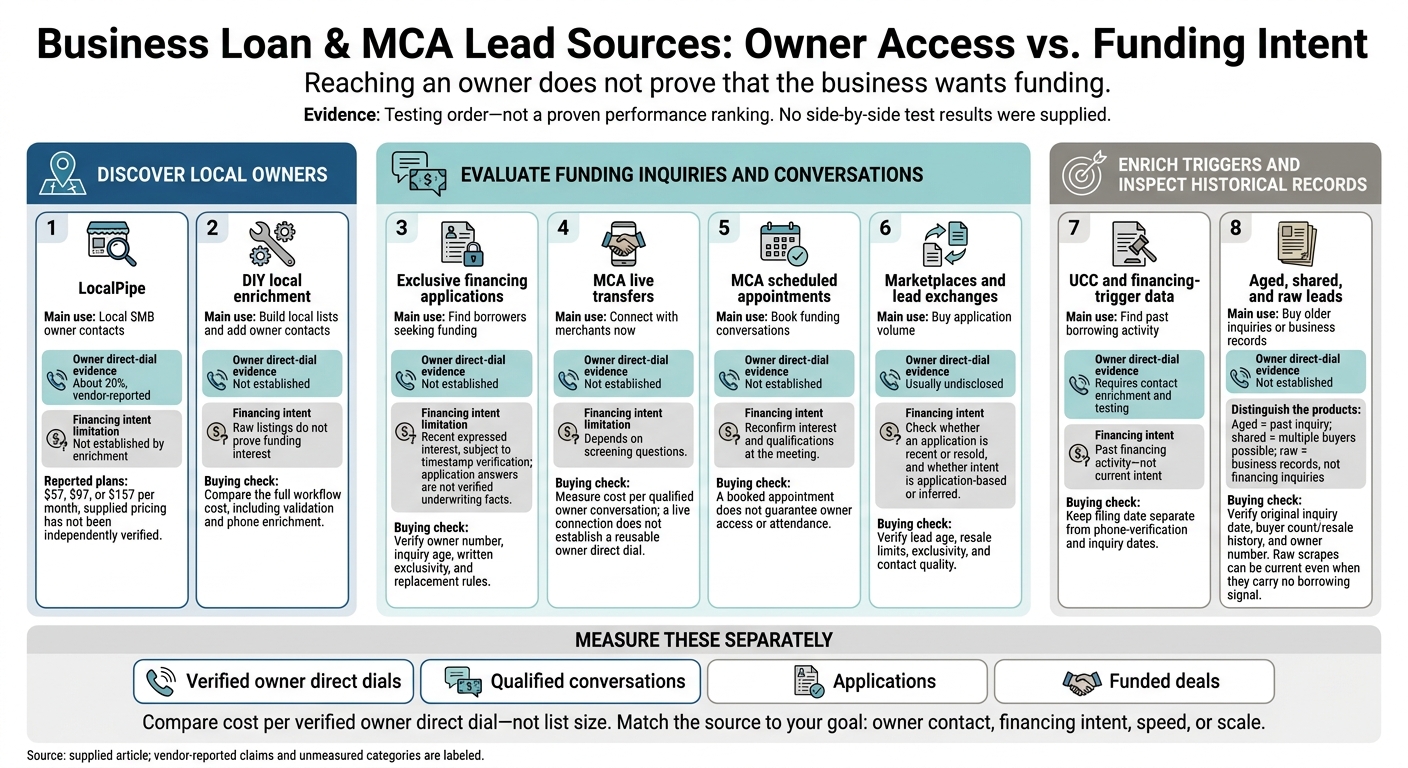
Business Loan & MCA Lead Sources: Owner Access vs. Funding Intent
How to Generate Merchant Cash Advance Leads (And What Data Works Best)
sbb-itb-3041e27
1. LocalPipe Google Maps Owner Enrichment
LocalPipe reports about 20% owner direct-dial coverage. Its separate 75% owner-identification rate - versus roughly 30% in DIY Clay workflows - measures owner discovery, not direct-dial yield. [2][4]
The main draw is build local business lead lists faster by finding owners. LocalPipe searches Google Maps by category and location, filters results using review and website signals, and cross-checks 11+ public sources to identify owners and add direct contact details. It’s best suited to local owner-operated SMBs, not financing-intent lists. [2][3][4]
Data updates on a reported seven-day cycle and on demand. But LocalPipe is a data layer, not a prebuilt list of leads showing financing intent. [3][4]
Plans cost $57, $97, or $157 per month, with credits spent only on successful returns. Each includes CSV export, API access, webhooks, unlimited seats, and a Clay template. [2][3][4]
Outscraper and Apify supply business listings; LocalPipe adds named owners and direct dials. Apollo and ZoomInfo are better suited to enterprise targeting than local SMB owner discovery. [2][4]
For a similar result without a dedicated platform, the next option is a DIY local-enrichment workflow.
2. Local Business Enrichment Workflows
A Clay-based DIY workflow may cost less than a dedicated enrichment platform, but its owner direct-dial rate is not established. Clay can combine raw local listings from Outscraper, Apify, or Scrap.io with a separate enrichment layer such as LocalPipe. Raw exports alone, though, don’t prove you can reach owners.[4]
Compare the full workflow cost - not just the export price. Outscraper starts at about $3 per 1,000 raw records. Add validation and phone enrichment, and the stack costs roughly $9–$14. Scrap.io and paid Apify plans start at around $49 per month.[4]
DIY results depend on how you build the workflow. Measure them with the same owner-direct-dial formula used in this article. Without owner matching and phone verification, cheaper raw data doesn’t mean more owner conversations.
Live scraping pulls current listings, while database exports, including D7 Lead Finder, can be months old.[1][4] Public listings are shared, not exclusive.[4]
Build a local prospect pool by category and geography, then qualify revenue and funding intent on the first call. If you need explicit financing intent, go beyond raw local prospecting.
3. Exclusive Real-Time Financing Applications
Exclusive financing applications reach buyers already seeking funding. But submitted phone numbers still need verification to distinguish business switchboards from direct lines to owners. Owner direct-dial rate: not established.[4][2]
The supplied evidence does not confirm provider pricing, speed, exclusivity terms, or replacement policies. Treat this as a category to vet, not a measured ranking.
Before buying, request timestamps, written exclusivity terms, resale limits, and replacement rules covering invalid numbers, non-owner contacts, duplicates, and borrowers who don’t meet qualification criteria. Compare price per accepted application, not the advertised lead price.
Filter applications by monthly revenue, time in business, credit profile, industry, state, and current financing. Assess value based on those filters and verified owner-contact quality.[4][2]
4. MCA Live Transfers
Live transfers connect brokers with merchants in real time. But no provider in the supplied material reports a verified owner direct-dial rate, so this category can’t be ranked on the article’s core metric.[4]
The channel helps brokers connect fast, but the person answering isn’t always an owner or decision-maker. Check transfer age, caller identity, and access to decision-makers. Compare prices by cost per qualified owner conversation; the supplied material doesn’t confirm pricing or replacement terms.
5. MCA Scheduled Appointments
A booked appointment doesn’t guarantee owner access. No provider here documents a verified owner direct-dial rate, verification window, or appointment price. Scheduled MCA appointments therefore remain unranked on this metric.
Ask for the owner’s name, how the number was verified, and when it last reached that owner - not a gatekeeper. Request the percentage of delivered bookings that include a verified owner direct-dial, plus written pricing and refund terms.
Next: marketplaces and lead exchanges, where scale usually comes with weaker exclusivity.
6. Business Loan Marketplaces and Lead Exchanges
Compared with live transfers and appointments, marketplaces give you more scale but less control. Owner direct-dial rates are usually undisclosed, so compare platforms by verified owner contact, exclusivity, and lead age - not advertised volume.
Marketplace-level pricing, speed, and distribution terms aren’t provided here. Request a written quote covering cost per accepted lead, delivery time, lead-age window, and exclusivity. Ask which filters are available for geography, industry, ratings, reviews, social presence, and phone-line type. Also, check whether financing intent comes from an application or is inferred from spending, revenue, and review trends.[4] Compare price, lead age, and exclusivity first, then test contact quality.
Application-based marketplaces show clearer financing intent than raw local lists. But they offer less certainty of reaching an owner than verified owner-enrichment workflows. They can work when you need scale, while direct-enrichment sources are better suited to owner-level dialing.
7. UCC and Financing-Trigger Data
UCC filings show past financing activity - not current intent. Pull records from Secretary of State offices, then filter by filing date, secured party, industry, and location to find businesses with recent borrowing activity. Cross-check filing details for owners and principals.[6] Treat UCC as a trigger source, not a ready-to-dial list.
Raw UCC exports still need enrichment. Added phone numbers aren't proven until they're matched and verified.[5][6] Next, check which records can become owner-direct-dial leads.
Verify owner lines on a sample of records. Log the pull date, the date phone ownership was verified, and how often records are updated. Line-type and carrier checks alone don't prove you can reach the owner. Judge UCC workflows by enrichment cost, verification window, and recency.[4][5][6] If UCC-trigger data is too indirect, the next source trades recency for cheaper volume.
8. Aged, Shared, and Raw Business Leads
These are three different products. Aged financing inquiries show past interest. Shared inquiries may have been sold to multiple buyers. Ask for the original inquiry date and, for shared files, the buyer count and resale history. Raw business lists identify businesses - not current financing intent - and still need cleanup and owner enrichment[5]. Age and exclusivity help determine whether these files are worth calling.
The supplied evidence includes no verified owner direct-dial rate. A Google Maps phone number doesn’t prove that a line reaches the owner directly. Before buying, request a 50-record sample and count only numbers verified to reach the named owner directly[5].
LeadsPlease static business lists start at $124.95 per 1,000 records. These are business records, not necessarily financing inquiries[5]. Low-cost volume doesn’t guarantee up-to-date owner contact details. Enriching local business data can update contact data, but it can’t turn an old inquiry into a current one.
Match your filters to what the source actually knows. Raw listings usually support category and geography; some databases also include SIC/NAICS codes, ratings, and review counts. For financing inquiries, ask whether revenue, time in business, and existing-financing fields are included - and when that information was collected. Don’t infer financing need from reviews or category labels[5]. Next, compare how age, resale, and exclusivity affect value.
Lead Costs, Age, and Exclusivity
Compare costs only after checking the owner direct-dial rate. Separate extraction cost, delivered-lead cost, and verified owner-contact cost. Only the last measures what you pay for reachable owners. Cheap records aren't a good deal if they don't reach owners.
| Source | Price/billing unit | Freshness window | Exclusivity/owner-dial note |
|---|---|---|---|
| LocalPipe enrichment | Monthly plans listed above; successful-result credits. Supplied pricing has not been independently verified.[2] | Same day to several days, depending on workflow | Confirm exclusivity terms; check owner-dial yield separately |
| Outscraper / Apify | Extracted records or actor usage[7][8][9][10] | Collection timestamp | Nonexclusive listings; owner contacts need separate enrichment |
| Aged or raw records | Illustrative: $0.25–$5 per record | Aged inquiries: 31–90 or 90+ days; raw records: collection date | Shared, resold, or unknown; owner dial unverified |
| Shared recent inquiries | Illustrative: $5–$40 per lead | 7–30 days | Multiple buyers; confirm resale limits and owner-dial verification |
| Exclusive qualified leads | Illustrative: $25–$150 per lead | Same day to 30 days | Define one-buyer exclusivity and its duration; verify owner dial |
| Live transfers | Illustrative: $50–$300+ per connected or qualified transfer | Real time or same day | Confirm transfer-window exclusivity; a connection doesn't establish a reusable owner direct dial |
LocalPipe credits aren't complete contact records. Different fields can use separate credits, while failed enrichments cost nothing.[2] Check field-level charges before estimating phone yield. For scrapers, count actor charges, minimums, enrichment, and export fees.
These ranges are planning bands, not vendor quotes. Ask for capture or enrichment timestamps and written definitions of “qualified” and “exclusive.” Those definitions should cover revenue, time in business, financing need, decision-maker status, and consent requirements. Audit consent and applicable U.S. telemarketing requirements before dialing.
Run a 30-day pilot and track verified owner dials, qualified conversations, applications, and funded deals separately. Require written replacement rules, then match each source to the borrower profile it fits best.
Borrower Targeting by Lead Source
The ranking measures contactability. Here, the focus shifts to borrower fit. Reachable owners are not always borrowers. Separate cold-owner sources from applications that show borrowing interest. Contact data is not underwriting data.
The source type determines which borrower fields you can trust.
| Lead source | Geography and industry | Revenue and time in business | Credit profile and funding purpose | Intent and filter limits |
|---|---|---|---|---|
| 1. LocalPipe Google Maps Owner Enrichment | Location/category | No verified borrower fields | No verified borrower fields | Cold-owner discovery |
| 2. Local Business Enrichment Workflows | Depends on the source | Depends on the source; may be estimated | Requires a qualified source | Enrichment does not prove intent |
| 3. Exclusive Real-Time Financing Applications | Application fields | Stated revenue and start date, if collected | Disclosed credit range and purpose, if collected | Recent expressed interest - not verified underwriting facts |
| 4. MCA Live Transfers | Screening criteria | Only if screened and supplied | Only if screened and supplied | Current interest depends on the screening questions |
| 5. MCA Scheduled Appointments | Booking criteria | Only if collected before booking | Only if collected before booking | Reconfirm interest and qualifications at the meeting |
| 6. Business Loan Marketplaces and Lead Exchanges | Marketplace fields and filters | Only if collected and disclosed | Only if collected and disclosed | Check whether the application is recent or resold |
| 7. UCC and Financing-Trigger Data | Filing coverage and business matching | Not established by the filing alone | No current credit or funding-purpose field | Trigger only |
| 8. Aged, Shared, and Raw Business Leads | Original list or application | Historical or absent | Historical or absent | Historical or no intent; raw lists carry no borrowing signal |
Ask for evidence for each field, not a generic qualification label. For applications, request the submission timestamp and the borrower’s actual answers. For transfers and appointments, ask for the screening questions and responses. For UCC records, keep the filing date separate from any outreach or inquiry date.
Store owner match, estimated revenue, and confirmed financing request in separate CRM fields.
Final Verdict: Choose a Source for Your Goal
Use this ranking as a working order - not a measured performance ranking. The first table compares owner reach. The second matches sources to buying goals.
| Source | Owner direct-dial evidence | Lead age | Cost | Tradeoff |
|---|---|---|---|---|
| 1. LocalPipe | ~20% direct-owner phone rate; internal benchmark [4] | Live; updated every 7 days [4] | From $57/month [2][4] | Owner-contact reference point; no built-in dialer/sequencer |
| 2. DIY enrichment workflows | Yield varies [2] | Depends on input data | Platform + enrichment | Flexible; requires setup |
| 3. Exclusive real-time financing applications | Unmeasured | Recent; verify timestamp | Quote required | Expressed intent, not verified owner access |
| 4. MCA live transfers | Unmeasured | Live; inquiry age varies | Quote required | Live access, not a reusable direct dial |
| 5. MCA scheduled appointments | Unmeasured | Booking/inquiry age varies | Quote required | Scheduled access; attendance and reusable direct dials unproven |
| 6. Business loan marketplaces and lead exchanges | Unmeasured | Recent or resold | Quote required | Scale; weaker exclusivity |
| 7. UCC and financing-trigger data | Unmeasured | Filing/trigger date | Quote required | Indirect signal; requires enrichment |
| 8. Aged, shared, and raw business leads | Unmeasured | Historical inquiries; raw scrapes can be live [4] | Low for raw data [4] | Historical intent or unverified contacts |
Rank alone doesn't determine purchase value. Match the source to your goal - owner contact, intent, speed, or scale - and check verified owner reach separately.
| Your goal | Best starting point | Buying rule |
|---|---|---|
| Low-cost local prospecting | Outscraper or D7 Lead Finder [4] | Add enrichment. |
| Owner-contact confidence | LocalPipe [2] | Test owner phones, not just names. |
| Financing intent | Exclusive real-time financing applications | Verify inquiry age and owner number. |
| Immediate conversations | MCA live transfers | Measure qualified conversations. |
| Corporate/enterprise targeting | Apollo or ZoomInfo [2] | Use corporate-role filters. |
| Raw local-list workflows | Outscraper or Apify [2][4] | Buy listings; enrich owner contacts separately. |
Before buying for owner contact, financing intent, or both, test 50–100 target businesses across two or three sources. Use the same verification rule to compare cost per verified owner direct dial, rather than judging by lead volume alone. [2][4]
FAQs
How can I independently verify owner direct-dial claims?
Test a representative sample of 100 records from each shortlisted provider. Manually verify the owner’s identity, confirm that the contact details belong to that person, and check whether you can trace the data to its source. Don’t rely on field-fill rates alone. Cross-check ownership against public records, BBB profiles, and social media.
Treat raw scraped listings as research starting points, not ready-to-use leads. Keep the original listing data separate from owner-contact fields. Before outreach, independently check email bounce risk and confirm that the contact details are valid.
Should I combine owner-contact lists with financing-intent leads?
Yes, but combine the data carefully. Financing-intent leads show which businesses are actively seeking capital. Owner-contact lists give you a direct line to the decision-maker.
Use listings from raw scrapers like Outscraper or Apify as a starting point - not a finished contact list. Enrich those records to identify owners and verify their contact details. LocalPipe specializes in this work, while general-purpose databases like Apollo are often less effective for local small-business owner data.
What consent do I need before calling business owners?
The search results cover data providers and owner-contact enrichment. They don’t explain the legal consent requirements for calling business owners.
Before making outreach calls, consult legal counsel or regulatory guidance about the telephone solicitation laws that apply in your jurisdiction.