10 best ZoomInfo alternatives for high-volume SMB prospecting in 2026
Compare 10 ZoomInfo alternatives for high-volume SMB outreach—test owner matches, verified emails/phones, and cost per usable contact.

10 best ZoomInfo alternatives for high-volume SMB prospecting in 2026
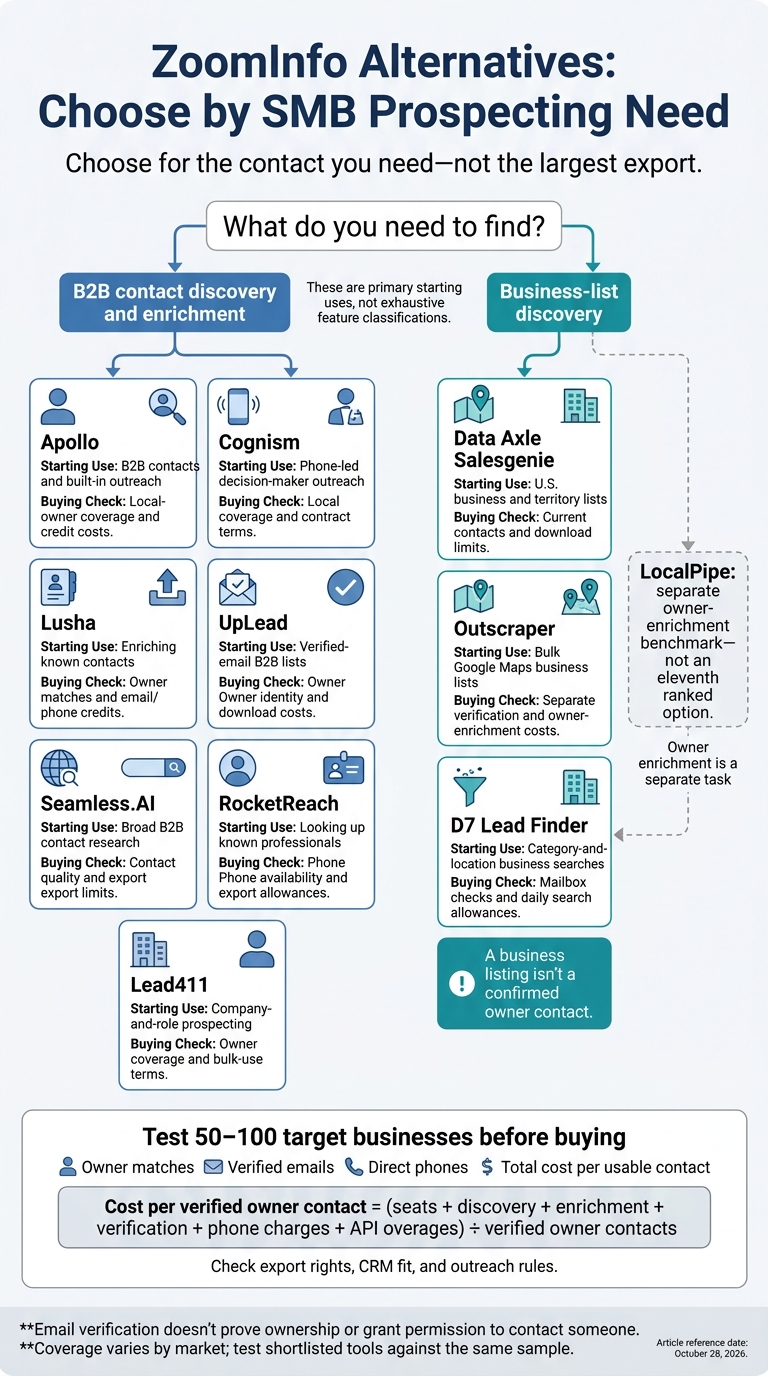
My advice: choose a ZoomInfo alternative based on who you need to reach - not how many rows you can export. Before buying, test 50–100 target businesses and compare owner matches, verified emails, direct phones, and total cost per usable contact.
For U.S. SMB outreach, I separate the options into two groups: tools that find people and tools that find businesses. A business listing isn’t a confirmed owner contact. And email verification doesn’t prove ownership or grant permission to contact someone.
Quick Comparison
| Tool | Best starting use | Main check before buying |
|---|---|---|
| Apollo | B2B contacts and built-in outreach | Local-owner coverage and credit costs |
| Cognism | Phone-led decision-maker outreach | Local coverage and contract terms |
| Lusha | Enriching known contacts | Owner matches and email/phone credits |
| UpLead | Verified-email B2B lists | Owner identity and download costs |
| Seamless.AI¹ | Broad B2B contact research | Contact quality and export limits |
| RocketReach | Looking up known professionals | Phone availability and export allowances |
| Lead411 | Company-and-role prospecting | Owner coverage and bulk-use terms |
| Data Axle Salesgenie | U.S. business and territory lists | Current contacts and download limits |
| Outscraper | Bulk Google Maps business lists | Separate verification and owner-enrichment costs |
| D7 Lead Finder | Category-and-location business searches | Mailbox checks and daily search allowances |
I use LocalPipe as a separate owner-enrichment benchmark, not an eleventh ranked option. In its vendor-run test of 500 plumbing businesses, it returned 258 verified sendable emails versus Apollo’s 26. That’s one market-specific result - not a promise for your list.
My buying rule: <u>add seats, discovery, enrichment, verification, phone access, and API fees before comparing costs</u>. Then check export rights, CRM fit, and outreach rules. Prices and allowances below are reference points as of October 28, 2026, not live quotes.
¹ Product name.
ZoomInfo Alternatives: Choose by SMB Prospecting Need
Top 5 ZoomInfo Alternatives in 2026 (Better Data, Lower Cost)
sbb-itb-3041e27
Compare coverage, contact quality, exports, and costs
Use the benchmark above to compare local-owner reach, verification, and export costs. The test is whether a tool finds reachable SMB owners - not just business records.
| Tool | Local SMB coverage | Owner evidence |
|---|---|---|
| Apollo | Better suited to professional and corporate contacts than local trades | Weak local-owner coverage in the benchmark |
| Cognism | Test target industries and geographies | Confirm local-owner matches |
| Lusha | Contact enrichment rather than broad local discovery | Confirm owner attribution |
| UpLead | Test target businesses and decision-makers | Confirm owner attribution |
| Seamless.AI | B2B discovery; test local trades | Weak local-owner coverage in the benchmark |
| RocketReach | Lookup-led; test local-business coverage | Confirm owner matches |
| Lead411 | Test owner-operated SMB coverage | Confirm owner matches |
| Data Axle Salesgenie | U.S. business targeting with SIC/NAICS filters | Confirm contacts are current owners |
| Outscraper | Google Maps scraping tools for business discovery | Listing extraction does not establish ownership |
| D7 Lead Finder | Category-and-location searches | Listing contacts do not establish ownership |
For tools without benchmark evidence, local-owner coverage depends on the market and needs vendor confirmation. Missing evidence doesn't mean a feature is unavailable. Sources: [1][5][6].
In LocalPipe’s 500-business plumbing benchmark, LocalPipe returned 258 verified sendable emails, compared with 26 for Apollo. This vendor-run test offers market-specific evidence, not a universal score. [5]
| Tool | Email reachability evidence | Decision point |
|---|---|---|
| LocalPipe | 258 verified sendable emails in the benchmark | Local-owner enrichment benchmark |
| Apollo | 5.2% verified email reach | 4.1% direct-owner mobile coverage |
| Seamless.AI | 7.0% verified email reach | 3.7% direct-owner mobile coverage |
| UpLead | Real-time verification; advertised 95% accuracy guarantee | Review credit-back terms |
| Outscraper | 12.0% verified email reach | Extracted emails may be generic inboxes |
Sources: [5][6]. Benchmark results are vendor-reported, not platform-wide accuracy measures. Verification doesn't establish ownership, and a listed phone isn't necessarily a direct line. Confirm both before buying.
Apollo offers Salesforce/HubSpot sync, and Outscraper supports API extraction. For the other tools, confirm export and API terms with the vendor. Get allowances in writing: searches, contact reveals, downloadable rows, and API requests are separate measures. [1]
10,000 records are not 10,000 usable owners. Compare verified owner contacts per dollar. The prices below are starting points, not volume quotes. [1][6]
| Tool | Source-backed entry price or model | Additional costs to confirm |
|---|---|---|
| Apollo | About $49/user/month, billed annually | Seats, credits, phones, API |
| Lusha | About $37/user/month, billed annually | Seats, contact credits, phones |
| UpLead | About $99/month | Credits, API, overages |
| Data Axle Salesgenie | About $149/user/month | Seats, downloads, API |
| Outscraper | Raw Maps data starts around $3/1,000 records | Extraction, validation, owner enrichment |
Sources: [1][6]. Entry prices don't establish total costs for 10,000 or 50,000 businesses. For the remaining tools, request quotes covering seats, credits, exports, and API access.
To calculate cost per verified owner contact, add seats, discovery, enrichment, email verification, phone charges, and API overages. Then divide that total by the number of verified owner contacts.
1. Apollo
SMB coverage and owner identification
Apollo helps you find named B2B contacts, not verified local owners. You can filter by geography, employee count, industry, and title, but Owner or Founder titles still need manual validation. It’s a B2B contact platform, not a source of local business lead lists. In a 500-business plumbing benchmark, LocalPipe found named owners for 76% of records, compared with 11.2% for Apollo.[5]
Contact reachability and verification
Apollo provides email and phone access, but a verified email doesn’t prove ownership. Verified email reveals typically cost one credit, charged only when Apollo verifies the address. Mobile-number reveals through its person-enrichment API can cost up to eight credits.[7][8] Before bulk reveals, check that the contact is the owner and the number is a direct dial.
Bulk exports and integrations
Apollo supports list building and outreach through CSV exports, bulk lookup, API workflows, built-in email sequences and templates, and a dialer. The free plan limits exports to 25 records at a time.[9] Before automating exports, confirm API limits, field mapping, and how duplicates are handled.
Pricing at scale
Apollo uses usage-based pricing, so costs at volume depend on searches, reveals, and API usage - not just seats.[8] Its combined prospecting and outreach workflow suits B2B teams building person-level contact lists rather than local-owner lists. LocalPipe fits owner-first local enrichment.[1]
2. Cognism
SMB coverage and owner identification
Cognism serves established SMBs through enterprise accounts, but it isn't a local-business directory. LocalPipe is a better fit for owner-first local outreach. Cognism works better for established SMBs and enterprise-style decision-maker lists.
Narrow your search by company size, geography, seniority, department, and job title. Then check local-owner coverage before buying.[11][13] Cognism is a person-level prospecting tool - not a source for live local-owner discovery.
Contact reachability and verification
Diamond Data verifies mobile numbers, not every contact field. Cognism also screens numbers against Do Not Call and TPS/CTPS registries. Check how often data is updated, how suppression lists are handled, and whether email validation applies to all records or only certain datasets. These checks support compliance, but they don't replace your calling policies or legal review.[10][12]
Bulk exports and integrations
Cognism supports CSV exports and connections to Salesforce, HubSpot, Outreach, and Salesloft. Confirm bulk-export caps and which fields are included. Get API access, rate limits, and CRM sync terms in writing as part of your contract.[11][13][14][15]
Use Cognism for verified decision-makers. Choose listing-first tools when the owner needs to come from a live local business record.
Pricing at scale
Ask for an annual total that includes credits, phone-verified data, exports, API access, overages, and renewal terms. Divide that cost by the number of usable, reachable decision-makers predicted by your validation sample.[14][15] For owner-first local enrichment, compare that figure with LocalPipe vs Outscraper rather than treating Cognism as a replacement for a local lead source.
3. Lusha
SMB coverage and owner identification
Lusha works best when you already have a target company or person and need fast enrichment. It’s less suited to finding owner-led local businesses from Maps. LocalPipe focuses on owner discovery using live local business records. [1] For Lusha, the key test is whether its owner match rate meets your needs in your target market.
Contact reachability and verification
Test 50 to 100 targets for correct-owner matches, bounce rate, and direct-dial connection rate. [1] If the match rate meets your needs, check whether export volume and workflow fit will limit your use.
Bulk exports and integrations
Before buying, confirm export caps, API access, and CRM connections. Lusha is also a native data provider in Clay waterfalls. That makes it an enrichment layer for known prospects - not a source for local owner discovery. [1]
Pricing at scale
Lusha offers a free tier, with paid plans starting around $37 per user per month, billed annually. Confirm current terms and request email and phone credit rates before estimating costs at your planned volume. Compare its cost per verified owner contact - not just its seat price - with LocalPipe’s pay-on-successful-find model. [1]
4. UpLead
SMB coverage and owner identification
UpLead suits teams that already know their target market and need verified contacts. It sits between broad B2B databases and local-owner enrichment, with a focus on filtered B2B prospecting - not owner-first local discovery.
Its 50+ filters cover industry, company size, revenue, location, title, and tech stack. But title filters identify likely owners; they don’t confirm ownership or decision-making authority. Use LocalPipe to find local owners and UpLead for account-based targeting through firmographic filters. [19][23][24][25][26]
Contact reachability and verification
UpLead verifies emails at download and advertises 95% data accuracy. It usually blocks invalid addresses from download, and later bounces may qualify for a credit refund.
These checks test email deliverability - not ownership, authority, or phone reachability. They also don’t guarantee future delivery. Check owner identity separately and confirm direct-dial coverage before buying at scale. This helps you avoid getting blacklisted when sending high-volume outreach. [17][18][19]
Bulk exports and integrations
Export limits need to match your volume. One credit unlocks one contact for export, including an email address and a mobile direct dial when available.
UpLead lists direct integrations with Salesforce, HubSpot, and Pipedrive, which can cut manual imports. API access varies by plan, so check the tier, rate limits, and credit usage. Confirm refund rules for unmatched enrichments, too. [17][20][21][22]
Pricing at scale
At scale, look beyond the sticker price to how fast you’ll use credits. Official pricing is $99 for 170 credits or $199 for 400 credits. When fully used, that works out to about $0.58 and $0.50 per unlocked contact, respectively.
Annual billing lists lower monthly equivalents of $74 for Essentials and $149 for Plus. Check current allowances and checkout terms before buying.
For 10,000 contacts, extra-credit pricing can have a large effect on your bill. Use UpLead selectively for qualified accounts, and track cost per usable prospect - not just per unlocked record. [17][19]
5. Seamless.AI
SMB coverage and owner identification
Where UpLead leads with verification, Seamless.AI focuses on broad contact discovery - not owner-first local enrichment. Its 100+ filters help target SMB segments, but a matching title still needs owner verification.[28] Test owner-match rates in your target ZIP codes. Choose Seamless for broader SDR contact research and LocalPipe for owner-operated local-business enrichment.
Contact reachability and verification
Seamless says it researches contacts on demand and returns verified emails and phone numbers. That doesn’t guarantee a connection, and its published materials don’t provide an independently audited accuracy rate.[30][32] Test email bounce rates and direct-dial connection rates, and verify emails independently before outreach. Before scaling, check export controls and API limits - not just headline search volume.
Bulk exports and integrations
Use Find or Find All for batch research. The API supports asynchronous search and retrieval workflows, and reported integrations include Salesforce, HubSpot, Salesloft, Outreach, and Pipedrive.[27][29][33][34][35] Confirm API access, export limits, batch size, and rate limits. Export limits vary by plan.
Pricing at scale
Once you know the export limits, estimate credit use. Searches cost 1 credit per 10 results, rounded up, plus 1 credit per enrichment. Batched searches therefore require roughly 1,100 credits per 1,000 prospects, 11,000 per 10,000, and 55,000 per 50,000, before retries or extra company enrichment. These are credit estimates, not dollar prices.[35]
Request single-seat, team, and agency-scale quotes. Get minimum seats, overages, credit rollover, and annual-versus-monthly terms in writing, then compare cost per reachable decision-maker, not credits purchased.[30][31]
6. RocketReach
SMB coverage and owner identification
RocketReach is a contact-discovery platform, not a local-business directory. Use it to find people at known companies by title, industry, or find local business owners by city. For live owner-first discovery, use LocalPipe; for raw business lists, use Outscraper.[41]
Contact reachability and verification
RocketReach treats a high-confidence email match, a valid phone match, and a database-only record as different results.[36] Its materials claim 90%–98% verified-email deliverability, but that’s a vendor claim - not a guarantee for your list.[42]
Check email confidence grades, assess phone availability separately, and confirm that the contact is the owner and find their phone number.
Bulk exports and integrations
Export limits are the main constraint when working at scale. Reported annual allowances are 1,200 on Essentials, 3,600 on Pro, and 20,000 on Ultimate.[37] Use the Chrome extension for live research. For larger batches, use CSV uploads, list imports, CRM exports, or API workflows.[39][37]
Reported integrations include HubSpot, Salesforce, Outreach, Salesloft, Bullhorn, and Zapier. Access and field mapping vary by plan.[37][38][40] The API uses the same credit logic as the interface, so check how searches and exports use credits.[36] Test a small target set before scaling up, since export allowances are capped.
Pricing at scale
Third-party sources list Essentials at about $399/year, Pro at $899/year, and Ultimate at $1,699/year. Confirm the price at checkout.[37]
To compare costs, divide your total spend - including any extra verification - by the number of usable owner contacts, not exported rows. Track how many verified owner contacts RocketReach delivers per dollar at your target volume.
7. Lead411
SMB coverage and owner identification
Like the other B2B databases here, Lead411 suits decision-maker prospecting, not owner-first local discovery. Ask how its signals and intent data help you decide which accounts to contact first.
Contact reachability and verification
Request a sample from your target cities. Have Lead411 separate named-owner emails and direct dials from generic inboxes and switchboards. Assess it for account lists and outreach - not for finding owners through Maps-first workflows.
Bulk exports and integrations
At high volume, export rules matter more than search access. Get written details on export caps, CRM integrations, API access, and overage fees. Search access does not equal export access.
Pricing at scale
Request a quote for your monthly volume that includes seats, intent data, API access, and overages. Compare the total cost per usable contact with LocalPipe’s pay-on-success model.[5][1]
8. Data Axle Salesgenie
SMB coverage and owner identification
Like Outscraper and D7 Lead Finder, Salesgenie works better for building B2B email lists than identifying confirmed owners. Data Axle Salesgenie is a U.S. business-list database, not an owner-enrichment tool. Reported coverage includes about 15 million U.S. businesses, with SIC/NAICS filters plus territory and radius searches. Treat named contacts as leads - not confirmed owners.[16][6]
Contact reachability and verification
Salesgenie’s strength is phone and direct-mail outreach, backed by human phone verification and NCOA address updates. Email coverage is partial, and a checked business record doesn’t guarantee a verified owner email.[16][6]
Use LocalPipe for owner-email discovery and Salesgenie for mail-ready territory lists. Salesgenie fits campaigns that need addresses and phone coverage more than named-owner verification.[16][6]
Bulk exports and integrations
At scale, export rules matter more than search counts. Before buying, confirm export caps, CRM transfer options, API access, and agency-use rights. Also ask whether suppression screening runs before export.[6]
Pricing at scale
Reported pricing starts at around $149 per seat per month. Confirm current rates and export limits before setting your budget.[16][6]
9. Outscraper
SMB coverage and owner identification
Outscraper finds local businesses, not verified owners. Search Google Maps by category, keyword, and location to get business names, addresses, phone numbers, websites, ratings, and review counts. It’s better suited to building local SMB lists than finding executives. Run separate searches for each category and city, then remove duplicates using business names, phone numbers, websites, and addresses.[47][48]
Contact reachability and verification
For outreach, contact quality matters more than listing volume. The separate Emails & Contacts Scraper can pull contacts from business websites, but finding an email doesn’t prove it belongs to an owner. Keep generic inboxes, such as info@ or sales@, separate from named contacts, and validate emails before outreach.[45][46] Use LocalPipe for named owners and verified direct contacts; use Outscraper for raw business listings.[1][5]
Bulk exports and integrations
Export results in CSV, Excel, JSON, or Parquet, or use the API for repeat collection.[43][44][49] Set places-per-query and total-results limits carefully; setting 0 removes the result-file cap. Split large jobs by category and location, record run dates, and test duplicate handling and API error recovery before importing into your CRM.[47][49]
Pricing at scale
Published pay-as-you-go pricing includes 500 free places, followed by $3 per 1,000 up to 100,000 and $1 per 1,000 above that.[43][44]
A 50,000-place extraction therefore costs approximately $148.50 before add-ons.[43][44]
Compare total cost per reachable owner, not just cost per listing, with LocalPipe’s model, which consumes credits only for successful results. Check current rates before starting a large task.[1][5] For a similar list-first workflow, compare D7 Lead Finder next.
10. D7 Lead Finder
SMB coverage and owner identification
D7 searches by category and location, returning company names, addresses, websites, emails, phone numbers, and social profiles.[50][52][53] Like Outscraper, it’s a list-first tool: records identify businesses, not verified owners. Use LocalPipe when you need named owners. Contact quality is the bigger limitation here - not list size.
Contact reachability and verification
D7 checks email syntax, domain acceptance, blacklists, and known spam traps. But it doesn’t confirm that a mailbox exists, so treat exported emails as candidates until you verify them separately.[51] Review counts and ratings can help you prioritize prospects, but they don’t prove you can reach them.[52]
Bulk exports and integrations
D7 supports CSV, Excel, and PDF exports.[50] Daily search allowances, rather than hard record caps, are the main constraint.[53] Plan summaries say Professional includes bulk search, REST API access, and five subaccounts.[54][55] Confirm the API access and subaccount terms before buying.
For high-volume use, check whether those daily search allowances can cover your monthly needs.
Pricing at scale
Published plan summaries put D7’s monthly pricing between $44.99 and $119.99: Starter costs $44.99 for 10 daily searches, Agency costs $54.99 for 30, and Professional costs $119.99 for 100.[56][57]
Those allowances cover searches - not guaranteed distinct records or reachable contacts. Compare the combined cost of the subscription, verification, and enrichment against the number of usable prospects you get. That tradeoff sets up the next comparison: database-style list building versus local-owner enrichment.
Pros and cons of B2B databases and local-owner enrichment
For high-volume SMB prospecting, the main choice is business-list data vs. owner-enrichment data. LocalPipe is a supplemental owner-enrichment benchmark, not an eleventh ranked alternative.
The table separates list-first tools from owner-first enrichment to help you match each platform to how you prospect.
| Provider and primary model | Main advantage | Main limitation at volume |
|---|---|---|
| LocalPipe - owner-enrichment benchmark | Provides a reference for measuring successful owner finds.[1][5] | No built-in outreach tools. |
| Apollo - B2B database and outreach | Combines professional-contact discovery with outreach. | Local-owner coverage can be thin. |
| Cognism - B2B contact database | Suits mobile-led prospecting for corporate decision-makers. | Less focused on independent local owners. |
| Lusha - B2B contact discovery | Enriches known people or companies. | Less useful for owners without a strong public profile. |
| UpLead - B2B database | Uses email verification to support targeted B2B contact lists. | Title filters don't confirm ownership. |
| Seamless.AI - B2B contact discovery | Searches for decision-makers at known companies. | Owner-match rates need testing in your target ZIP codes. |
| RocketReach - contact lookup | Finds contact details for identified people. | Less suited to discovering an entire local-business market. |
| Lead411 - B2B database | Supports company-and-role prospecting. | Not built for Maps-first owner discovery. |
| Data Axle Salesgenie - business-list database | Supports geographically defined SMB lists. | A listed contact isn't proof of current ownership. |
| Outscraper - raw listing extraction | Suits bulk business-list collection. | Owner enrichment requires separate work to enrich local business data and costs. |
| D7 Lead Finder - local-business discovery | Builds business lists by category and location. | Owner identification and mailbox verification remain separate tasks. |
Coverage varies by market, so test every shortlisted tool against the same target sample.
LocalPipe combines live, on-demand local search with owner matching based on public records and web signals. It also supports CSV, API, webhook, and Clay workflows.[1][5]
If you're considering LocalPipe, compare credits per usable contact - not seat price. Use the pricing table below as an owner-enrichment reference. Before calculating cost per usable prospect, confirm how owner names, emails, phones, and exports use credits. API access and unlimited seats are described as included with all paid plans.[1][58]
| LocalPipe plan | Supplied monthly price | Credits | Owner-name finds | Business-record exports |
|---|---|---|---|---|
| Starter | $57 | 2,000 | 1,400 | 4,000 |
| Growth | $97 | 5,000 | 3,500 | 10,000 |
| Pro | $157 | 10,000 | 7,000 | 20,000 |
Before buying, test 100–500 records from your target market. Remove duplicates, then count named owners, verified person-level emails, and direct phone numbers separately. Check CRM mapping, API limits, and how the tool handles opt-out suppression. Choose the plan that meets your contact-volume needs within budget.
The next section turns these tradeoffs into recommendations by market, volume, and budget.
Final recommendations by market, volume, and budget
Choose for the contact you need - not the largest export. Use the comparison below to match your market, list volume, and budget.
| Prospecting need | Best starting point | Trade-off | Alternative |
|---|---|---|---|
| Local-owner outreach | Outscraper or D7 for discovery; LocalPipe for owner enrichment | Finding businesses does not give you verified owner contacts | DIY Clay enrichment |
| U.S. SMBs with public digital footprints | Apollo | Owner-operated businesses without professional profiles may be underrepresented | UpLead or Lusha |
| Occasional bulk local lists | Outscraper’s pay-as-you-go model | Raw records still need qualification and enrichment | Data Axle Salesgenie |
| Focused contact lookups and smaller teams | Lusha for quick enrichment | Credit use climbs fast at scale | RocketReach or Lead411 |
| International or multilingual prospecting | Cognism | Confirm coverage, compliance support, and quoted costs | Apollo, UpLead, or Lusha for mostly U.S. lists |
For large U.S. list-building campaigns, start with Data Axle Salesgenie. If your budget is tight, remove unqualified businesses before paying for enrichment. Choose DIY Clay only when custom filters and waterfall enrichment justify the setup time. Before scaling, check export allowances, API rate limits, and overage costs.
Run a pilot before you buy. Compare market coverage, owner match rate, verified contact rate, bounce rate, export limits, and cost per usable SMB prospect.
Before launch, check that source licenses allow your intended collection, enrichment, export, storage, resale, and client use. Review privacy obligations and retention rules.
Apply CAN-SPAM requirements: accurate headers, a valid postal address, a clear opt-out method, and prompt suppression of unsubscribed recipients. Have qualified counsel check applicable TCPA requirements, federal and state calling rules, consent requirements, do-not-call screening, calling hours, and texting rules.
Verified contact data does not grant outreach permission.
FAQs
How can I verify ownership of a local business?
To find a local business owner, you need more than a business listing. Outscraper, Apify, and Scrap.io provide listing data, not owner contacts. Apollo and ZoomInfo focus on corporate profiles, so they may miss local owners.
LocalPipe focuses on local business enrichment. It identifies owners by name with an approximately 75% find rate and provides verified owner emails and direct phone numbers - not generic inboxes.
When should I combine lead sources instead of using one?
Combine lead sources when you need business listings in bulk and verified owner contacts for outreach. One source alone may leave gaps in coverage or data quality.
Use raw scrapers like Outscraper or Apify to collect Google Maps business listings in bulk. Then enrich those results with LocalPipe to get verified owner emails and direct phone numbers. This keeps raw data collection costs low while giving you more accurate contacts for outreach.
How often should I refresh my SMB prospect lists?
Update and verify your SMB prospect lists right before each outreach campaign. Local business information changes often, so use live, on-demand enrichment rather than static databases that may be out of date [1][2].
LocalPipe scrapes and verifies owner contact details on demand [1][2]. If you use Outscraper or Apify, run a new extraction and verify the results through a third party before outreach. Treat lists as temporary assets that need revalidation - not permanent records [1][3][4].